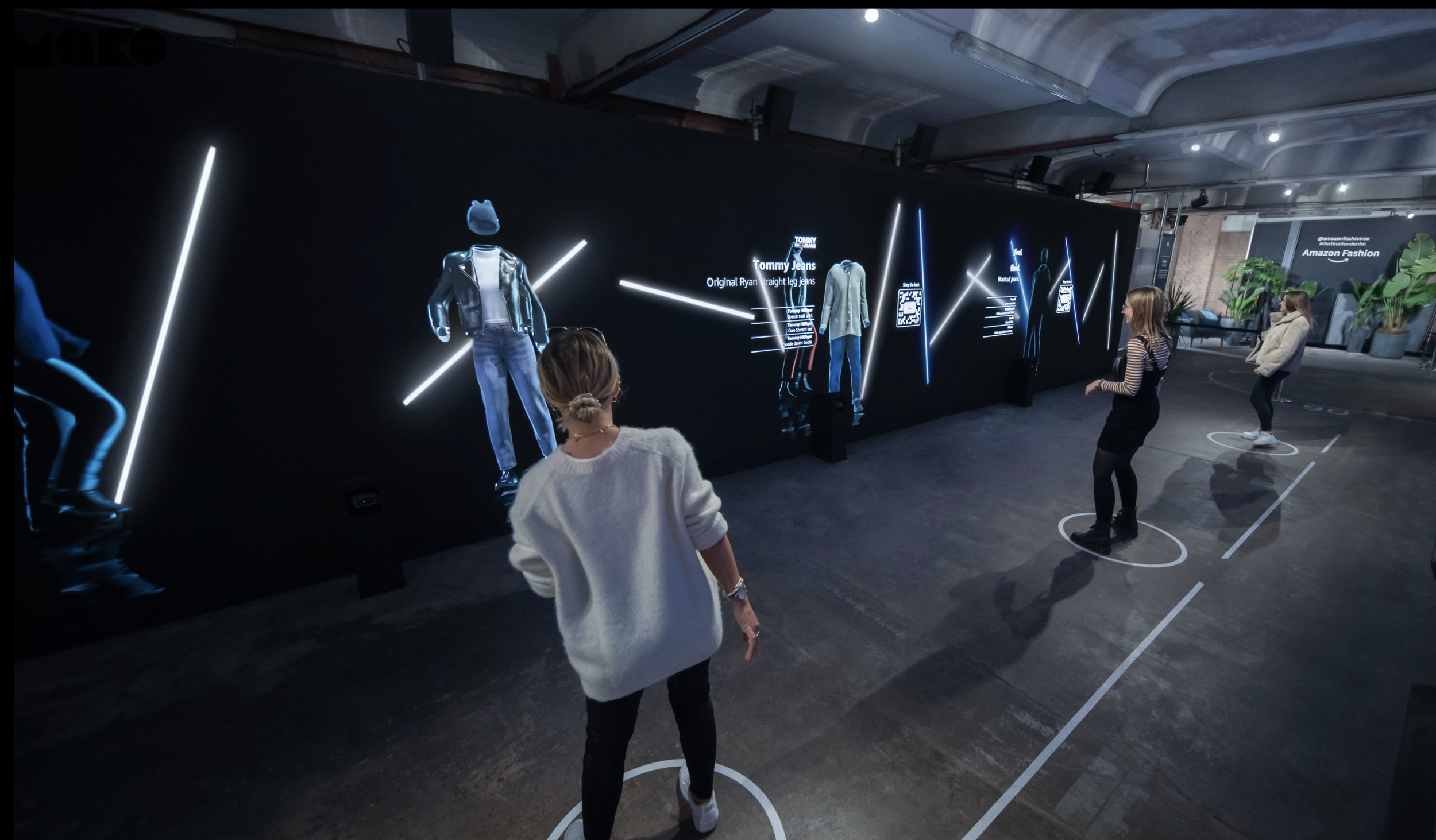
Amazon – Interactive Styling Installation
Retail · Voice & Conversational UX · Physical–Digital Experience
Year
2019
Conversational UX starts with data structure, not dialogue
Context and product
As part of an interactive in-store installation, Amazon created a voice-guided styling experience powered by Alexa. In a futuristic “dressing room” environment, customers could describe their style preferences and receive personalised denim recommendations from Amazon’s extensive catalogue.
The exeprience:
The experience was designed to feel conversational and exploratory rather than transactional—inviting users to talk about style, not search for products.
Problem space
Traditional product discovery relies on screens, filters, and typing. In a physical retail environment, this approach would not have worked.
The challenge was to:
Enable hands-free, voice-led discovery
Translate complex product data into natural, conversational questions
Create an experience that feels intuitive, playful, and fast in a noisy public space
Deliver reliable results despite very real-world constraints such as acoustics and crowd noise
Approach and process
The largest part of the work happened before any actual interface design:
Sorting, structuring, and prioritising product data
Identifying which attributes (fit, cut, rise, wash, style) were meaningful in a spoken interactionDesigning the conversational logic
Mapping how Alexa would guide users from vague preferences to a concrete recommendation, and help and deal with error recovery and ambiguityUX writing & voice scripting
Writing and refining voice prompts, confirmations, and responses
Translating and adapting the entire experience in English and German, accounting for linguistic and cultural differences, rather than direct translationScenario design & testing
Different test scenarios were developed to anticipate possible user behaviours such as unclear answers, changes of mind, and interruptions.
Design focus and decisions
Turning structured product data into human-friendly dialogue
Designing questions that feel open but still lead to meaningful results
Supporting voice interaction with visual cues in the physical space
Keeping cognitive load low in a public, time-limited setting
Real-world implementation challenges
One of the most interesting aspects of the project was the on-site setup at the exhibition.
Test scenarios had been conducted in controlled environments, but the live setting introduced:
Unexpected acoustics
Background noise and overlapping conversations
Different user behaviour in a public space
This required last-minute adjustments to voice prompts, pacing, and error handling to ensure Alexa could reliably understand users and keep the experience flowing.
Outcome and impact
My role
UX Designer focusing on conversational UX, data structuring, UX writing, and on-site implementation.
Worked closely with engineers, data teams, and exhibition staff.
The installation demonstrated how voice interaction can meaningfully support product discovery in physical retail environments.
It was a particularly rewarding project that combined conversation design, information architecture, UX writing, localisation, and hands-on delivery—from concept through live implementation.